Boxcar Get in touch
What cloud did for infrastructure, Boxcar does for software.

Stop shipping software nobody can explain.

“One prompt, ship it” produces software whose hundreds of small decisions are arbitrary, untracked, and yours to defend later. The strongest software, like the strongest writing, comes from authors who understand the outline, the style, and the pivotal moments - not from authors who were surprised by their own book. Boxcar is the managed substrate that lets a team and its coding agents work that way together: deliberate, collaborative, durable, easy to change.

Pressure-tested in aerospace, healthcare, finance, retail, manufacturing, and more Join the waitlist for early access
Velocity with convictionTeams ship faster because the menu of choices is already curated, vetted, and shipped in production - the hard decisions don’t get re-fought every project.
Earned wisdom, inheritedWorry about your innovation, not all the stuff all software needs to function - audited, accessibility-tested, and proven under load.
Risk under your controlPlain-language governance docs compile into agent constraints. Update the doc; the agent’s allowed behavior changes.
Workflow Autonomy Envelope
jw PDF
↑ Severity
Confidence →
SELECTED · BLOCKED
REQUIRES STAGING PROOF

Manage Rules (4)

1 drift
db.dropTable
RED blocked 5/4/2026, 9:06 AM

Proposed cleanup of user_sessions_legacy - superseded by user_sessions_v2 in March.

68%
95%
Azure
Gemma
Triggered by rule
Destructive DB ops require staging proof

Database Safety Runbook §4 requires staging parity before any irreversible operation in production.

Scoring breakdown

Base severity (data.destructive)+80
Production environment+20
Migration confirmed in staging−20
Irreversible+15

The three layers

The structural claim

What the substrate handles for you.

Operational toil moves into the platform. Hard-won pattern choices arrive without you having to make them. You own your business logic and your governance; we deliver the substrate.

Layer 1

Earned Library

An opinionated catalog of patterns, decisions, and best practices - shipped in production from aerospace OEMs to hospitals, and other high-stakes operators. The conviction is the value.

Layer 2

Constrained Agents

Coding agents that can only operate on Layer 1’s vocabulary and your governance rules. Plug in harnesses like Claude Code or use our provided private-LLM agent harness for teams that value privacy and green compute.

Layer 3

Living Documents

Strategy, research, design, workflows, governance - all first-class entities with relationships to each other and to the code. Update a persona, the relevant code paths know. Review the who and why, when decisions were made.

Pencil-on-graph-paper sketches: progress indicators, launch-vs-landing time charts, dependency progress bars, and design notes for an autonomous mission-control concept.
Concept
A live operations dashboard with a globe live-satellite view, data status tracker, machine-vision cameras, fuel-cells heat map, alerts panel listing pressure and ingress events, and a launch-window timeline.
Fully working software
Solution Spotlight Aphelion Aerospace · NASA SBIR

Autonomy that isn’t isolation - even at twenty two minutes for round trip signals.

Aphelion Aerospace and Boxcar built a fully autonomous, real-time AI for launch operations in environments where humans have to stay in the loop but can’t possibly be in the moment - environments like a Mars launch, where one round trip of communication averages twenty two minutes. Differentiable deep learning and agentive models on the edge with the vehicle, paired with terrestrial cloud compute for what doesn’t have to ship. The result enabled mission profiles that simply couldn’t be designed before - and proved that fully autonomous systems can still be part of a human-centric journey, with accountability and collaboration preserved by design.

  • Mission profiles previously impossible to design - the human can’t be in the moment, but is still in the loop.
  • Edge inference on the vehicle, terrestrial cloud for what doesn’t have to ship; intent and policy travel together.
  • Accountability preserved by design - autonomy is not the same as isolation, even at twenty two minutes.
  • Human collaboration scaled across light-minutes, not erased by them.
CTXAGTVALCHG
Is Your Company an AI Company?

Agentive Software Readiness Check

A short self-assessment that shows where your AI work is connected, where context is leaking, and where fast experiments may be quietly becoming fragile operational dependencies. Tap an answer for each question - your maturity level updates live.

Q1When AI helps with real work, where does the operational context live?
Q2Who decides what an AI agent is allowed to inspect, change, or execute?
Q3Can your team trace why a major workflow or AI-touched feature exists?
Q4What happens when a useful AI experiment becomes business-critical?
Q5How do AI agents and humans agree on what data means in your domain?
Q6How do you detect and contain a misbehaving agent or prompt-injection attempt?
Q7Is AI adoption tied to outcomes that actually move the business?
Q8When a system needs to change, can humans and agents pick up the right context?
Where Layer 1 was forged

Pressure-tested in environments where mistake costs go beyond dollars.

Most software-development tools are pitched by founders whose deepest war story is a CRUD app. Boxcar’s patterns ship in production for organizations whose mistakes cost lives, money, and time. Software development is hard. It's littered with failures. Boxcar is a proven platform for success from decades of hard learned lessons.

Healthcare & Life Sciences

Patterns hardened by clinical workflows, medical-device interfaces, and PHI handling - where “we’ll fix it next sprint” isn’t an option and no systems like to talk to each other by default.

Hospitals · Med-tech · Payers

Aerospace

Decisions and rationale preserved across programs. Autonomy boundaries designed for export-controlled work. Layer 1 grew up in environments where a defect can cost a mission - and brings that discipline to work for every industry.

Avionics · Programs · Sustainment

Financial Services

Customer-facing automations, explanation driven model decisions, and risk signals where the system has to be defensible long after the original team has moved on. The audit trail is the artifact, not a reconstruction.

Banking · Insurance · Capital markets

Manufacturing & Industrial

Agents that touch MES, SCADA, and ERP systems can’t treat “move fast” as a value - downtime is measured in dollars per second. Boxcar’s patterns are how a useful experiment becomes a stable line tool without a quality incident in between.

OT/IT · Operations · Engineering
A voice-driven hazardous-materials classification interface - the system has flagged radioactive alpha contamination, locked conveyor belt C, and is asking the operator to confirm the assessment in their own vocabulary.
Solution spotlight A production line that includes hazardous-materials

The line stops itself - in the operator’s lingo.

Classification used to be the bottleneck on this line: too risky to handle, too dependent on tribal knowledge, too expensive to standardize. The team replaced it with a fully touchless system that listens, watches, and learns from each operator. When something breaks the rules - an off-spec radiation signature, a tag mismatch, a confidence drop - the conveyor halts, the comms channel goes quiet, and the system walks the operator through the call in their own vocabulary.

  • Touchless voice-and-vision interface keeps hands clear of the material entirely.
  • Operators teach the system on the job; classifications get sharper with use, no retraining cycle. Operators get super-attention abilities over long shifts.
  • Belt halts and actionable decisions are deterministic - capability sits inside guardrails, not next to them.
  • Operators describe the AI as “having my back” - retention and confidence with measurable benchmarks.
CTXAGTDATVAL
Inside Layer 3

Continuous discovery, connected to the code.

Modern product teams don’t ship from a static brief. They run continuous discovery, map opportunity-solution trees, test their assumptions, and connect those decisions to the user stories engineers (and agents) actually deliver. Boxcar treats every one of those artifacts - interviews, opportunities, journey maps, governance docs, user stories, etc - as a first-class entity, linked to each other and to the code. The result isn’t documentation that decays; it’s the team’s thinking, stored where it can still be acted on a year later.

Boxcar Platform showing an Opportunity Solution Tree: a desired outcome at the top, two opportunities below it, two solutions branching from those, and a User Stories panel on the right with an open story, acceptance criteria, and a 'Must' priority.
Opp Tree view, with user stories attached to the opportunity that justifies them.
For product & design

Discovery as a living tree.

Outcomes, opportunities, solutions, and the tests that decide between them all live in one Teresa-Torres-style Opp Tree - with interview synthesis, journey maps, and personas linked in. No more decks that decay the moment the kickoff meeting ends.

For engineering & agents

The why ships with every diff.

Each user story carries the opportunity it serves, the desired outcome it laddered up to, and the alternatives the team considered. Engineers and coding agents pick up the same context, build from the same constraints, and write the same acceptance criteria.

For the team that inherits this

Replayable thinking, not archaeology.

Six months from now, a new PM, engineer, or agent walks the tree to see why each call was made, what was rejected, and what was tested. Maintenance starts with the discovery that justified the build - not with reconstructing it from chat threads.

Why now

A single prompt does not remove the hard decisions. It just hides who made them.

Every serious AI-enabled workflow contains choices about policy, permissions, data shape, exceptions, escalation, security, reliability, cost, approval, and value. When those choices aren’t captured, organizations get automation without accountability and speed without control - the same pattern that turned spreadsheets into critical infrastructure, only faster.

The default pattern

“Build something that automates this process.”
“Let an agent handle the exceptions.”
“Connect it to our data and ship it.”
  • ×
    Judgment becomes invisible.The model fills gaps your team never discussed.
  • ×
    Autonomy becomes accidental.A useful shortcut quietly turns into an operational dependency.
  • ×
    Governance becomes cleanup.Security, compliance, and support inherit a system after the risk is already live.

The intentional pattern

Define intent → map workflow → set autonomy limits → enforce security checks → capture decisions → approve risk → measure value → evolve deliberately.
  • Important choices stay visible.Humans and agents work from a shared model of what matters.
  • Autonomy has boundaries.Agent permissions, blocked actions, review gates, and escalation paths are explicit.
  • Value is measured.Teams track whether AI actually improves adoption, quality, speed, cost, or customer experience.
What we are not

Boxcar is an AI app builder, a no-code platform, a coding-agent wrapper, or a citizen-developer tool.
Those make it easier to ship AI. Boxcar makes it safe to keep what you shipped.

The lifecycle layer

The missing lifecycle layer around software, workflows, and AI agents.

Boxcar turns documentation into an active system for design, delivery, governance, distribution, measurement, and change. It is where serious AI-enabled work stays connected while it happens - six pillars, one substrate.

CTX

Shared context infrastructure

Business intent, domain rules, examples, architecture, data contracts, risks, and change history stay connected for humans and agents.

DEC

Decision memory

Capture who decided what, why it mattered, what alternatives were considered, and what evidence supported the choice.

AGT

Autonomy boundaries

Define what agents can inspect, suggest, draft, change, execute, or deploy - and where review is mandatory.

DAT

Clean data by default

Keep definitions, dependencies, interfaces, and dashboards aligned as experiments become workflows and workflows become apps.

VAL

Value measurement

Connect usage, adoption, quality, cost, risk, customer experience, and operational outcomes back to the purpose of the work.

CHG

Change paths

Update living documentation, regenerate plans, revise implementation, and preserve rationale as the system evolves.

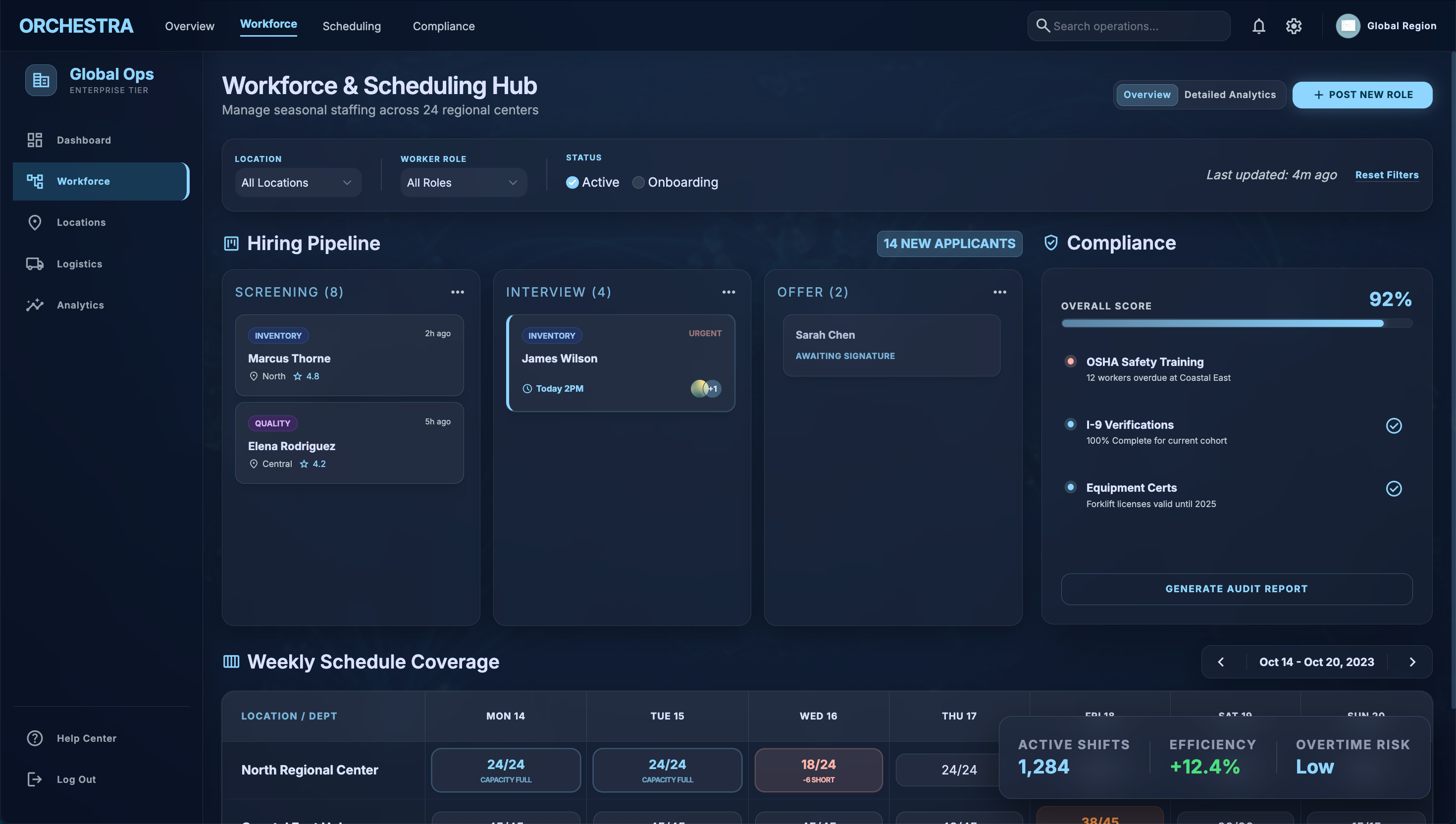
A multi-region workforce and scheduling dashboard showing hiring pipeline, compliance posture, weekly schedule coverage across regional centers, and a live operations efficiency metric.
Solution spotlight A multi-region service operator

Local autonomy. Shared rigor. Half a million in licensing back in value in the first week.

A service operator running dozens of regional locations had the classic federation problem - every region wanted (and needed) its own way of working, but without shared documentation, success measures, or AI scaffolding, every region was reinventing the same things and licensing the same tools five times over. Boxcar gave them one substrate where each location kept its operating autonomy on top of standardized intent, success metrics, and an explainable-AI hiring signal a regional GM can actually defend.

  • $500K+ recovered per year on consolidated licensing alone.
  • Standardized documentation and shared success measures landed across all regions without removing local discretion.
  • Explainable-AI recruiting that hiring leads can defend in plain language - ethics holds up in writing, not just in policy.
  • Compounding gains in talent retention, operational efficiency, customer experience, and risk posture - tracked, not asserted.
CTXDECDATVALCHG
Lifecycle

From an AI experiment to a shipped capability - without restarting from a stale doc.

Boxcar moves promising AI work out of isolated chats and demos into workflows, applications, dashboards, and operational systems without silos of data that your team can ship, measure, evolve, and defend if they ever have to.

01
Discover Problems, users, risks, value, and operating realities.
02
Structure Workflows, data, domain rules, examples, and interfaces.
03
Govern Autonomy envelopes, approval points, and accountability.
04
Build Engineers and coding agents, working from one context.
05
Distribute Deploy, train, and support with rationale intact.
06
Measure Usage, adoption, quality, risk, and business value.
07
Evolve Update intent, docs, and implementation together.
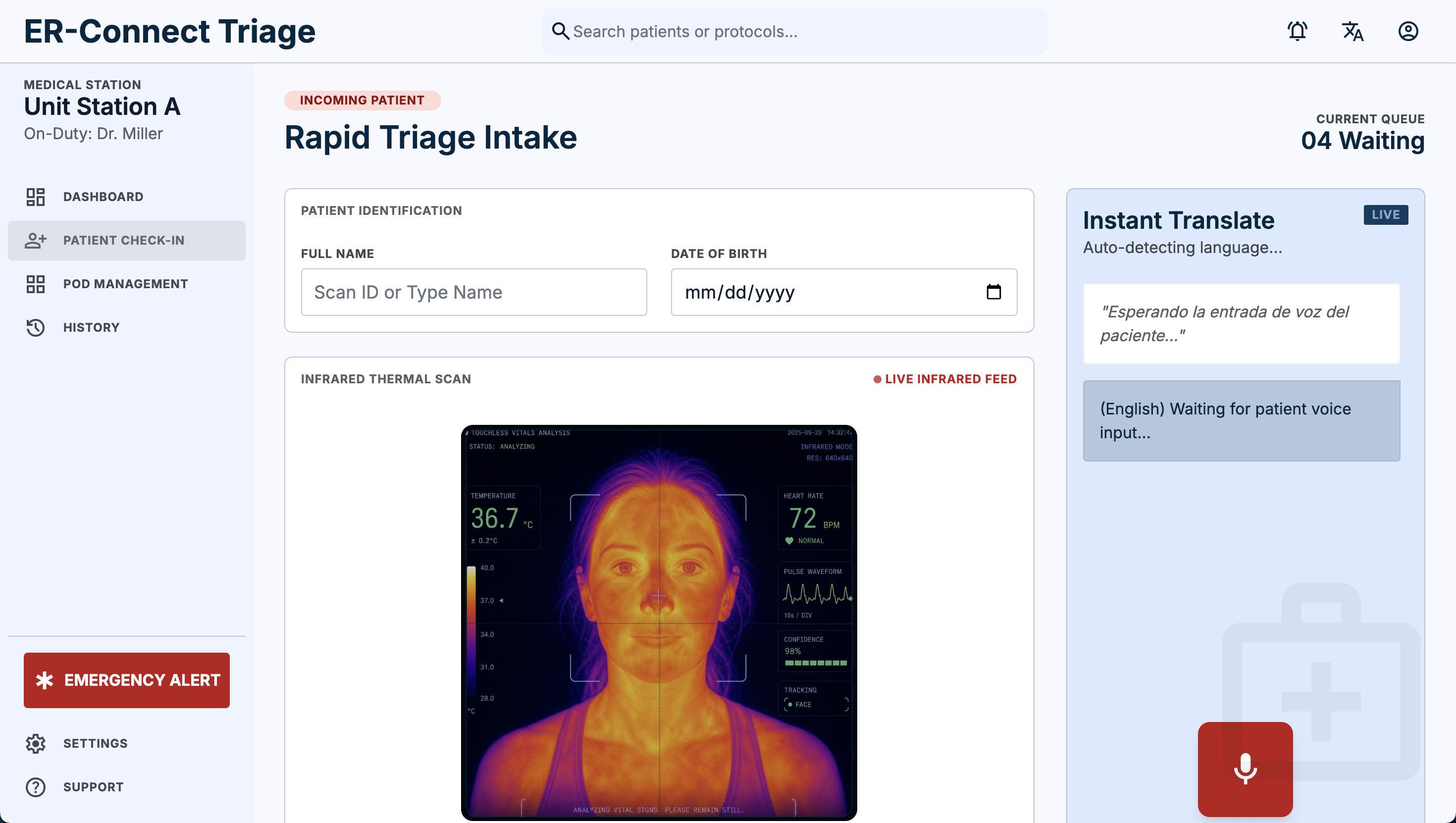
An emergency-department rapid-triage intake screen showing patient identification, an infrared thermal scan deriving heart rate and temperature vitals, and a real-time language-translation panel listening for patient voice input.
Solution spotlight A hospital's emergency department

Non-clinical staff. Clinical-grade triage.

An emergency department needed front-desk staff to handle accurate triage on incoming patients without operating outside their training or leaking private patient history. The team built a multi-modal intake: an IR camera that derives heart rate and temperature from frame-over-frame color amplification, a privacy-respecting lookup against the patient’s prior visits, real-time language translation, and RPA (robotic process automation) bridges into legacy systems with no API. Every patient outcome feeds historic and real-time analysis - surfaced disparities then become the next features the system ships.

  • Contactless vitals (HR, temperature) from a standard IR camera plus subtle-color amplification.
  • Real-time language translation - born from a disparity the outcome analysis surfaced, not from a feature backlog.
  • RPA bridges to proprietary systems with no API, so urgent data extraction and recording stays within authorized and accountable provider workflows.
  • Outcome telemetry feeds the roadmap directly - measurement is the continuous-improvement loop.
CTXDATVALCHG
Shared context infrastructure

The same context that makes experts better makes agents experts.

Engineers, domain experts, analysts, and AI agents are different in important ways. But serious work asks the same thing of all of them: understand the problem, respect the constraints, follow the patterns, ask for approval, and connect the work to value.

Human expert

Better judgment with deeper context.

Engineers, operators, analysts, and product leaders make better tradeoffs when they can see the business intent, domain rules, prior decisions, examples, constraints, and value targets all in one place.

Boxcar living context

One operating model for people, systems, and agents.

Boxcar structures the knowledge both humans and agents need to contribute safely and coherently - versioned, queryable, and connected to the lifecycle decisions it should inform.

Intent Domain rules Data contracts Branding and UX "Voice of" Studies Architecture Examples Approvals Risks Value measures Change history
AI agent

Effective autonomy with explicit boundaries.

Agents perform better when the task is grounded in clear context, accepted patterns, allowed actions, blocked behaviors, review gates, and measurable success criteria rather than open-ended prompts.

Agentive Software Design

AI tools are not enough. Organizations need a practice.

No matter how smart AI gets, the future of work is the disciplined practice of embedding non-deterministic AI into deterministic software, workflows, and operations where humans and agents work together intentionally, visibly, and safely. The platform exists to make the practice routine.

Training & certification
01
Separate deterministic systems from non-deterministic assistance. Know what must be reliable, testable, and governed - and where AI can safely accelerate or augment the work.
02
Make intent explicit before implementation. Define the purpose, constraints, users, data, and value measures that should guide both people and agents.
03
Authorization that is fine grained. Use autonomy envelopes, examples, security checks, review gates, and approval paths so agents can help without silently expanding risk.
04
Measure value through the lifecycle. Track usage and outcomes against the original reason the software was built. Recalibrate when the work stops creating value.
05
Preserve the why as the system changes. Future teams should inherit more than code. They should inherit the thinking behind it.
Deployment postures

Three ways to run it. One product.

Most platforms force a tradeoff between privacy and capability - free with someone else’s data center, or expensive with someone else’s data center. Boxcar lets the customer pick the security posture they need, on infrastructure they already control.

Local Desktop

Single user, fully offline.

Works on a plane, in a SCIF, on an air-gapped workstation. Everything stays on the device. The right posture for evaluation, sensitive analyses, and individual contributors who can’t send code anywhere.

  • No network required, export and import projects
  • Local LLM
  • BYO Claude / OpenAI / Gemini / Fireworks.AI key, optional
Best for evaluation · individual product development · Apache 2
LAN / Local Collab

A small team, owner originators host.

Peer-to-peer collaboration. One developer’s machine acts as the host per project; the rest of the team connects on the LAN or over a VPN. Useful for closed networks, customer-site engagements, and teams that don’t need a server tier.

  • Peer-to-peer, no server
  • Host elects on the LAN deliberately
  • Local LLM agent supported, or BYOK (Bring Your Own cloud llm Key)
Best for small teams · closed networks · Apache 2
Enterprise

Server-mediated, scaled, governed.

Postgres-backed, RBAC, SSO, audit log, data residency. Deployed on the customer’s own tenant or on Boxcar-managed infrastructure. The right posture once the work is operational and the system needs to be defensible.

  • Postgres + role-based access
  • SSO, audit log, data residency
  • Architected for regulated-environment review
Best for production scale · multi-team · enterprise license
Identity, integrations, and keys

Fits the identity stack you already have.

IT shouldn’t bolt their identity around a vendor’s assumptions. Boxcar layers onto SSO, directory services, and key management you already operate - on whichever side of the BYOK / managed-keys line your org sits.

Real authorization, not "we have SSO."

Five identity paths so IT can match Boxcar to existing posture instead of standing up a new one. Layered with domain allowlists, JIT vs. pre-provisioning, built-in roles, custom view-whitelist roles, and per-project ACLs.

  • Microsoft EntraSilent desktop SSO
  • Google WorkspaceOIDC + domain allowlist
  • SPNEGO / KerberosAD-joined corporate machines
  • Email OTPOne-time codes, no IdP
  • Magic linkFrictionless guest access
  • RBAC + per-project ACLsBuilt-in roles & view whitelists
Layered: domain allowlist · JIT or pre-provisioned · built-in roles · custom view-whitelist roles · per-project ACLs

Bring your keys, or never see them.

Most AI vendors pick one and lose half the market. Boxcar supports both ends - the org with negotiated LLM contracts and the org that doesn’t want anyone touching API keys.

BYOK
Bring your own LLM keys.

Anthropic, OpenAI, or your private deployment. Negotiated contracts and existing rate limits stay yours; Boxcar reads from a vault you control.

Managed keys
Server-managed, IT-locked.

For teams that explicitly don’t want individuals near API keys. Boxcar manages credential rotation; usage and spend are observable from the admin plane.

Local-only
No keys at all.

Pair with Boxcar’s private-LLM agent against a local model on the developer’s laptop or your private cloud. No third-party model ever sees the code.

Two perspectives, one platform

Uniting Business and IT

In today's fast changing world, business needs systems as adaptable as the landscape around them. IT needs to enable the business to succeed while protecting it from an equally rapidly evolving set of challenges and threats.

Business Leaders

“How do we innovate faster and compete?”

Transforming Work

The platform lets your teams move at the speed AI now makes possible - with the audit trail, the rule-firing rationale, and the human-in-the-loop where it matters. Growth, efficiency, brand, and visibility all move forward together.

  • Velocity from pre-vetted patterns, not a blank page
  • Outcomes connected to the original purpose of the work
  • Empower employees and delight customers, while measuring the results
  • United strategy while listening to every voice, even when everyone is busy
Technology Leaders

“Will deploying this make my next quarter harder or easier?”

Fits your identity, network, and key posture.

SSO and SPNEGO meet your existing IdP. RBAC and ACLs meet your project model. BYOK or server-managed keys meet your contract. Three deployment postures meet your data-classification reality. You can pilot without procurement and harden without re-platforming.

  • SSO, RBAC, audit log, data residency - on day one
  • Local desktop → LAN/VPN → enterprise, same product
  • BYOK, managed keys, or no keys at all
  • Open-source core and well defined plugins and extensions for safe upgrades
Open core + enterprise lifecycle

Open where trust matters. Enterprise where scale demands it.

Boxcar’s open-source core gives teams a transparent foundation for Agentive Software Design. Enterprise capabilities add lifecycle dashboards, distribution controls, integrations, advisory support, and the governance surface you need when AI work moves from experiment to operational system.

Open-source core

Foundation, in the open.

Inspect, extend, and adopt the foundational model without hiding your software lifecycle inside a vendor black box.

  • Apache 2 licensed
  • Self-hosted or fully managed
  • MCP & A2A integrations
  • Local LLM friendly
Training & advisory

The practice, taught.

Help engineers, product leaders, advisors, and partners learn the practice of Agentive Software Design - and embed it.

  • Workshops & certification
  • Implementation partners
  • Custom plugins & integrations
  • Strategic advisory
What we believe

Three convictions shaping every decision we make.

These three principles are load-bearing - they predict every architectural and methodological choice we make, from the autonomy envelope down to how we license the core.

01 / Future of work

Empower people to do what wasn’t possible before - not just automate what’s always been done.

Most enterprise AI is being aimed at the wrong target: shave a few minutes off a task that already worked, and call it transformation. That’s a productivity tax, not a future.

We believe the real opportunity is the work that nobody attempts today because it’s too expensive, too uncertain, or too slow for a human alone - the analysis that gets skipped, the simulation that’s too costly to run, the customer signal that goes unread. AI’s job is to put that work in reach. Boxcar exists so the people closest to the problem can attempt it without losing the rigor that made the work matter.

Lift the ceiling, not just the floor.
02 / How work happens

Collaboration, not isolation.

The default mode for AI today is one person, one chat, one private outcome. Productive in the small, corrosive at scale: knowledge gets stranded, context evaporates between sessions, and the same investigation is repeated by three different people in three different tools.

We believe AI should make organizations more connected, not less. Agents and humans should work in the same shared context, on the same artifacts, with decisions visible to everyone who comes next. A great AI system makes a team smarter together - not a few individuals faster in private.

Shared context beats personal cleverness.
03 / How systems should be built

AI is table stakes. Software determinism is the framework that makes it safe.

Models will keep getting more capable. That alone won’t produce systems anyone - customers, partners, the next engineer to inherit the codebase - can actually trust. The differentiator going forward isn’t which foundation model you call. It’s the deterministic structure around it: explicit policies, versioned contracts, testable boundaries, decisions you can replay.

We believe the best path forward is a software framework where humans and AI both operate - where probabilistic capability is wrapped in deterministic structure. That’s how speed and accountability stop being a tradeoff. It’s also how an organization stays sovereign over its own systems as the underlying models change beneath them.

Determinism is what makes intelligence operable.
Get in touch

Ready to put AI on rails?

Tell us about the work you’re trying to bring into a real lifecycle - whether the goal is velocity, evidence, both, or something else entirely. We can't wait to hear your ideas.

We're excited to hear from you

One workflow. Real stakes. Let’s map it.

Whether you’re evaluating design thinking strategy based software, looking for a workshop for your team, or curious how the open core fits with your stack - this form is the right place to start.

  • Share the assessment from the readiness check above and we’ll bring matching examples.
  • Tell us the workflow you’d most like to put on rails.
We don’t share or sell your data.